12 min de lecture
12 mars 2026
New Palmyra Pro Packages Bring Structured Traceability to Cocoa Cooperatives
New Palmyra Pro Packages Bring Structured Traceability to Cocoa Cooperatives
Palmyra Pro has launched a clear package model for cocoa cooperatives, making it easier for organizations to adopt traceability and compliance infrastructure based on their operational needs. Instead of treating digital traceability as a custom enterprise project from day one, the new structure gives cooperatives a practical path to start with core operational tools and expand into more advanced compliance workflows as they grow.
At its core, Palmyra Pro is positioned as end-to-end traceability and compliance infrastructure for global supply chains. The platform connects physical commodities with digital records, creating structured and verifiable workflows from origin to market. For cocoa cooperatives, that means moving away from fragmented spreadsheets and disconnected reporting processes toward a governed system that captures farmer data, plot information, batch activity, custody transfers, and compliance status in one place.
Three Packages for Different Stages of Operational Maturity
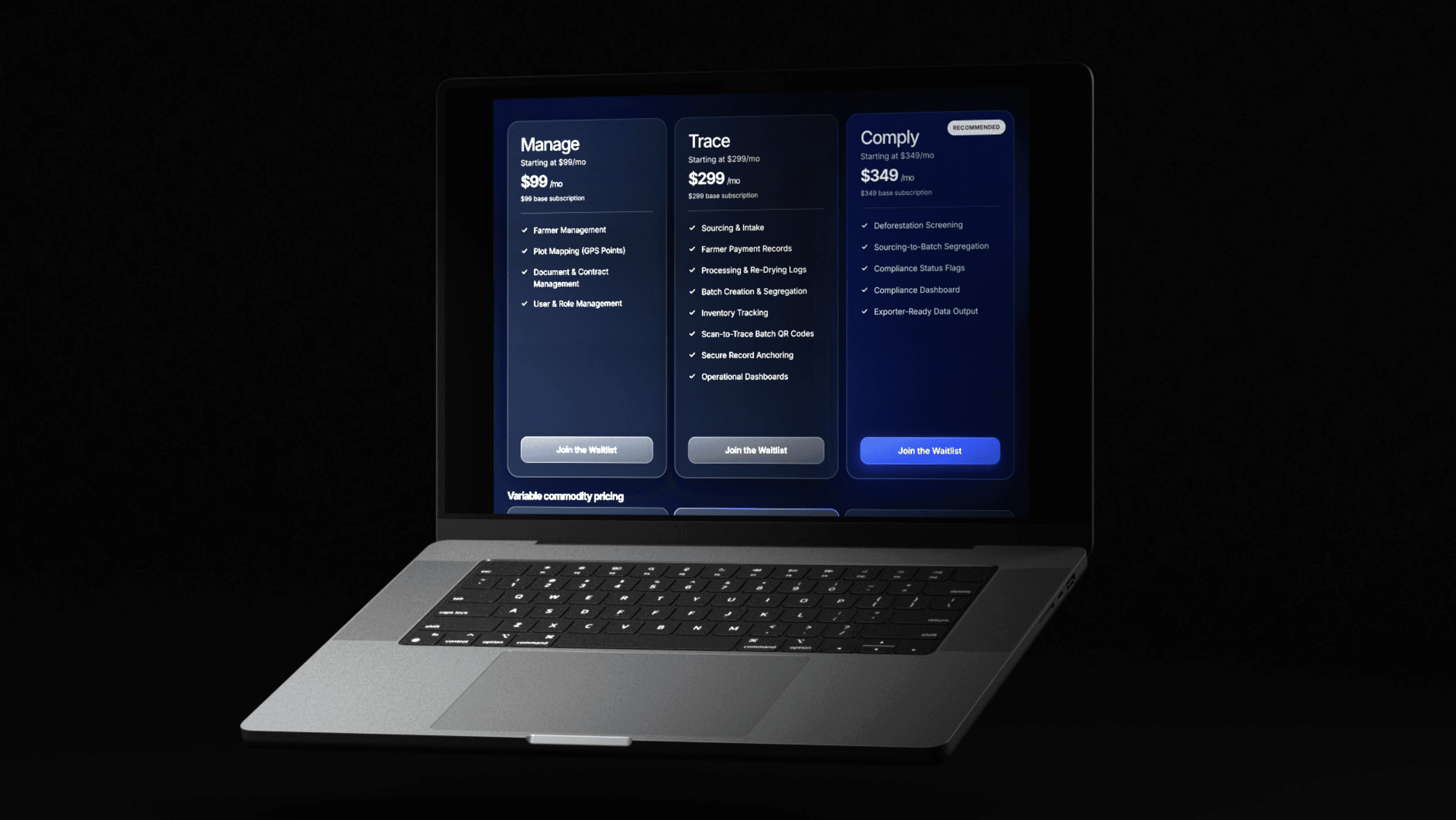
The new pricing model is built around three tiers: Manage, Trace, and Comply.
The Manage package is built around a $99 base subscription plus variable usage fee. This package focuses on the foundational operational layer that many cooperatives need first. It includes Farmer Management, Plot Mapping using GPS points, Document & Contract Management, and User & Role Management. In practical terms, this tier gives cooperatives the ability to onboard producers, organize farm records, structure internal permissions, and begin building reliable digital records at the field level.
The Trace package is priced at $299 base subscription plus a variable usage fee. This tier expands Palmyra Pro into batch-level operational traceability. It includes Sourcing & Intake, Farmer Payment Records, Processing & Re-Drying Logs, Batch Creation & Segregation, Inventory Tracking, Scan-to-Trace Batch QR Codes, Secure Record Anchoring, and Operational Dashboards. This is the level where a cooperative begins turning farm and intake activity into continuous traceability infrastructure. Instead of only registering farmers and plots, the cooperative can now track how cocoa moves through sourcing, processing, segregation, and storage.
The most advanced package, Comply, is priced at $349 per month plus a variable usage fee. This tier is designed for cooperatives and supply chain actors that need direct compliance functionality. It includes Deforestation Screening, Sourcing-to-Batch Segregation, Compliance Status Flags, Compliance Dashboard, and Exporter-Ready Data Output. This package clearly targets organizations preparing for stricter trade environments, where geolocation, sourcing separation, and structured compliance outputs are becoming essential for export readiness.
Pricing Also Scales With Cocoa Volume
Beyond the package subscription, Palmyra Pro introduces variable commodity pricing tied to annual cocoa volume. The pricing tiers shown are:
0–500 tonnes per year at $5 per tonne
501–3,000 tonnes per year at $4 per tonne
3,001+ tonnes per year at $3 per tonne
This is important because it aligns the platform with real cooperative scale. Smaller organizations are not forced into the same model as large multi-thousand-tonne operators, while larger cooperatives benefit from lower per-tonne pricing as volume increases. It also reflects Palmyra Pro’s broader positioning as infrastructure designed to scale with complex operations rather than remain fixed as a one-size-fits-all tool.
More Than Software, Built as Operational Infrastructure
Palmyra Pro supports structured workflows across every stakeholder, coordinating producers, cooperatives, processors, exporters, and buyers within one governed environment. It is also described as infrastructure that turns field data into verifiable records by capturing production events, GPS coordinates, batch creation, custody transfers, and documentation in real time. This matters because many cooperatives do not fail due to lack of data collection alone. They struggle because information is stored in disconnected formats and cannot be carried consistently through sourcing, batching, and compliance processes.
Palmyra Pro also emphasizes scalability and interoperability. The platform is designed to scale from pilot programs to large operational rollouts and to integrate with existing ERP systems, financial tools, IoT devices, certification bodies, and blockchain infrastructure. That positioning is particularly relevant for cocoa supply chains, where digital tools often fail because they are introduced as isolated systems rather than as part of a broader operational architecture.
Core Modules That Match Real Supply Chain Needs
The platform’s core modules reinforce that infrastructure approach. Palmyra Pro includes Custom Workflows, allowing organizations to define sourcing, processing, and custody flows that match how they actually operate. It also includes Governance, so roles, permissions, and approvals can be structured internally.
On the traceability side, Palmyra Pro is built around continuous links between producers, parcels, batches, and custody transfers. Chain of Custody and Audit Trail are key features, showing that the platform is designed to preserve time-stamped records ready for verification. For compliance-heavy markets, the platform also includes EUDR-ready structured origin and geolocation data and Data Anchoring for immutable proof on blockchain.
These are not minor details. They show that the product is designed for real operational and regulatory use cases, not just surface-level traceability claims.
Add-Ons for Deeper Deployment
The package structure also leaves room for expansion through add-ons. Training & Onboarding, Farm Mapping Support, Data Migration, ERP Integration, Advanced Analytics, and Premium Support. These are custom quoted separately and not included in the displayed package totals.
That matters because it gives cooperatives flexibility. Some organizations may only need software access and internal onboarding. Others may require field support to accelerate polygon mapping, migration from existing spreadsheets, or deeper analytics once the data layer is in place.
A More Practical Model for Cocoa Cooperatives
Overall, the new Palmyra Pro package model makes the product far more concrete for cocoa cooperatives. Instead of speaking in broad terms about traceability and compliance, the platform now shows a clear operational ladder.
Manage establishes the producer and plot layer.
Trace adds batch, inventory, and process continuity.
Comply introduces screening, compliance intelligence, and exporter-ready outputs.
In a cocoa market where buyers increasingly expect structured origin data, batch segregation, and compliance-ready records, that clarity matters. The cooperatives that build these workflows early will be in a stronger position to operate confidently as market requirements continue to rise.
