16 min de lecture
2 févr. 2026
How a Cocoa Bean Travels Before It Becomes Chocolate
How a Cocoa Bean Travels Before It Becomes Chocolate
A chocolate bar feels simple. You unwrap it, break a square, and taste something familiar.
What’s less familiar is the journey that made it possible.
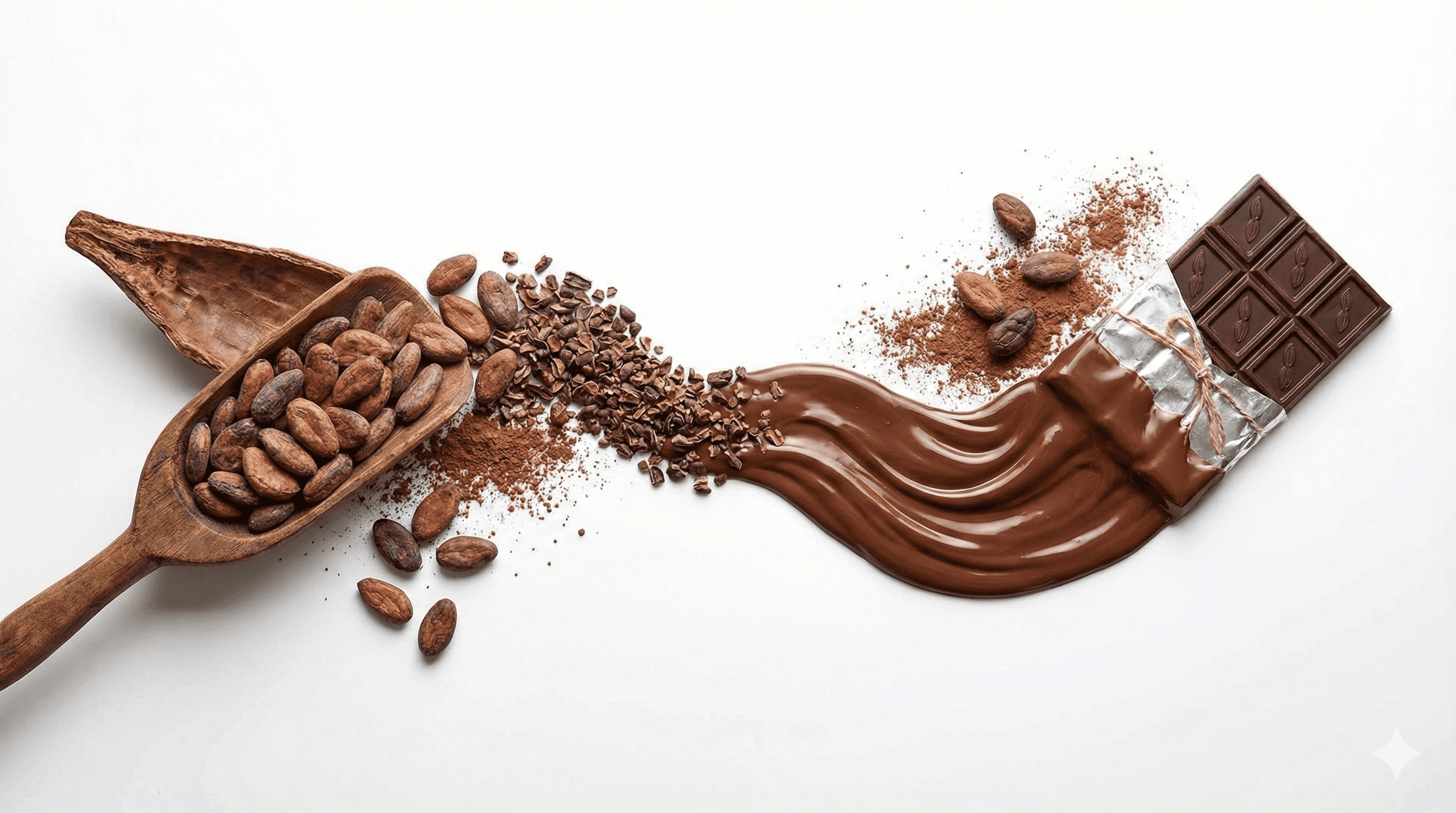
Before cocoa becomes chocolate, a single bean can pass through more than a dozen hands, cross multiple borders, and lose most of its original identity along the way. Understanding this journey explains not only why cocoa is difficult to manage, but also why origin, quality, and accountability are so fragile in this industry.
This is the life of a cocoa bean, step by step.
1. It Starts Inside a Pod
Cocoa doesn’t grow as a dry bean. It grows inside a football-shaped pod, hanging directly from the trunk of a cocoa tree. Each pod contains 30 to 50 seeds surrounded by sweet white pulp.
Farmers harvest pods manually, using machetes or pruning tools. Timing matters. Too early and flavors are underdeveloped. Too late and beans can begin to deteriorate. Already, quality is being set long before anyone talks about markets or prices.
At this stage, the cocoa bean has no documentation, no batch number, no identity. It exists only on the farm.
2. Fermentation: Where Chocolate Is Born
Once pods are opened, the wet beans are fermented, usually in wooden boxes, baskets, or heaps covered with banana leaves. This process lasts between four and seven days.
This is the most critical transformation in cocoa. Fermentation develops the precursors of chocolate flavor. Miss a turn. Cut the process short. Over-ferment. Each mistake permanently alters taste.
Yet fermentation is rarely measured or recorded. In many regions, hundreds of farmers ferment simultaneously with different methods, but their beans may later be mixed together.
At this point, cocoa already has hidden differences that the market may never see.
3. Drying and First Aggregation
After fermentation, beans are dried in the sun or mechanical dryers until moisture drops to safe levels. Too much moisture leads to mold. Too little and beans become brittle.
Once dried, farmers usually sell to local buyers or cooperatives. This is the first major aggregation point. Beans from many farms are pooled together, often by village or region.
This is where the cocoa bean starts to lose its individuality. A high-quality batch and a poor one can now sit side by side, visually indistinguishable.
4. Transport to Buying Centers and Warehouses
From local buyers, cocoa travels to regional buying centers or cooperative warehouses. Here, it may be weighed again, rebagged, and stored.
Quality checks are typically superficial: visual inspection, cut tests, moisture sampling. Detailed origin data rarely moves with the beans. What matters now is volume, not story.
By the time cocoa leaves the region, it may represent the output of hundreds or thousands of farms.
5. Export Blending and Shipment
At export warehouses, cocoa is graded, standardized, and prepared for shipment. Beans from different districts, cooperatives, and even harvest periods may be blended to meet contract specifications.
Once loaded into containers and shipped, cocoa officially becomes an export commodity. Documentation exists now, but it describes the cargo as a whole, not the farms inside it.
The cocoa bean has crossed borders, but its past is already abstracted.
6. Arrival at Processors and Grinders
When cocoa reaches importing countries, it is processed by grinders. Beans are roasted, cracked, and ground into cocoa liquor, butter, and powder.
From this moment on, physical traceability becomes nearly impossible. Liquids and powders from multiple shipments are combined in industrial systems designed for efficiency, not separation.
The cocoa bean no longer exists as a bean. It exists as an ingredient.
7. Manufacturing and Branding
Chocolate manufacturers take cocoa derivatives and combine them with sugar, milk, and other ingredients. Recipes vary. Origins are sometimes highlighted, sometimes hidden.
A bar labeled “West African cocoa” can contain beans from tens of thousands of farms. A “single origin” label requires extraordinary discipline to maintain.
For most chocolate, the journey is complete, but the story is simplified.
What This Journey Reveals
The cocoa supply chain was built for scale, not memory.
At almost every stage, cocoa is mixed, pooled, and standardized. This makes the system efficient, but it also explains why:
Quality feedback rarely reaches farmers
Origin claims are difficult to verify
Problems like adulteration or mislabeling are hard to detect
Sustainability claims rely on estimates, not certainty
Once identity is lost early, it cannot be recovered later.
Seeing Cocoa Differently
Understanding this journey changes how we think about chocolate. Cocoa is not just grown and sold. It is transformed, blended, and abstracted long before it reaches consumers.
Making cocoa more transparent doesn’t mean rewriting this journey. It means capturing information as it happens, before identity disappears.
This is where modern traceability quietly fits in. Not as a marketing layer at the end, but as infrastructure along the way.
Platforms like Palmyra Pro are designed to preserve continuity across this journey, connecting farm-level data, processing events, and trade documentation into a single, verifiable thread.
Because once you know how far a cocoa bean travels, you understand why remembering where it came from matters.
